
Imagine this: You, a manager, are stepping into a one-on-one with your newest team member. You’ve noticed they’ve been quiet all week, doing everything they can to avoid eye contact. You learn that it’s because they’ve missed the deadline on their first project.
Do you:
- Dive straight into the missed task, pointing out what went wrong?
- Start with small talk, hoping to ease them into admitting the problem?
- Ask open questions to understand what happened and how you can support them?
When it comes to leading a team, there is rarely ever one “right” move. But a leader’s response to tricky situations shapes how their team shows up, performs, and grows.
So what’s a manager to do?
Two words: Situational leadership.
Situational leadership is a framework for managers built on the idea that your leadership style should adapt to the needs of who you’re leading, not what works best for you.
Leadership has long been stereotyped as a male role, with the assumption that traits such as control and dominance are pre-requisites for effective leadership. Situational leadership flips that notion on its head by prioritising emotional intelligence, adaptability, and empathy.
That’s why this International Women’s Day (8th March), we’re talking about situational leadership to help female leaders show up for their teams authentically without diminishing their own authority.
As Anise Frost, Leadership Consultant at Thrive 4D, puts it, “Today’s complex workplaces demand cognitive flexibility and emotional resilience, making women uniquely suited for the adaptive nature of situational leadership.”
Take a moment to hear how female leaders across Zinc exemplify this:
In this blog you’ll learn:
- What situational leadership is
- How you can apply it at work,
- Why it's the key to unlocking your team’s potential
Let’s dive in.
What is situational leadership?
Situational leadership, developed in 1969 by Paul Hersey and Ken Blanchard, is an approach in which leaders adapt their style based on an employee’s competence ( skill) and commitment ( will) to complete a specific task.
By understanding their employee’s past experience, knowledge, and confidence in their ability to complete the task, leaders gauge how involved or hands-off their leadership style should be.
Situational leadership model has four styles:
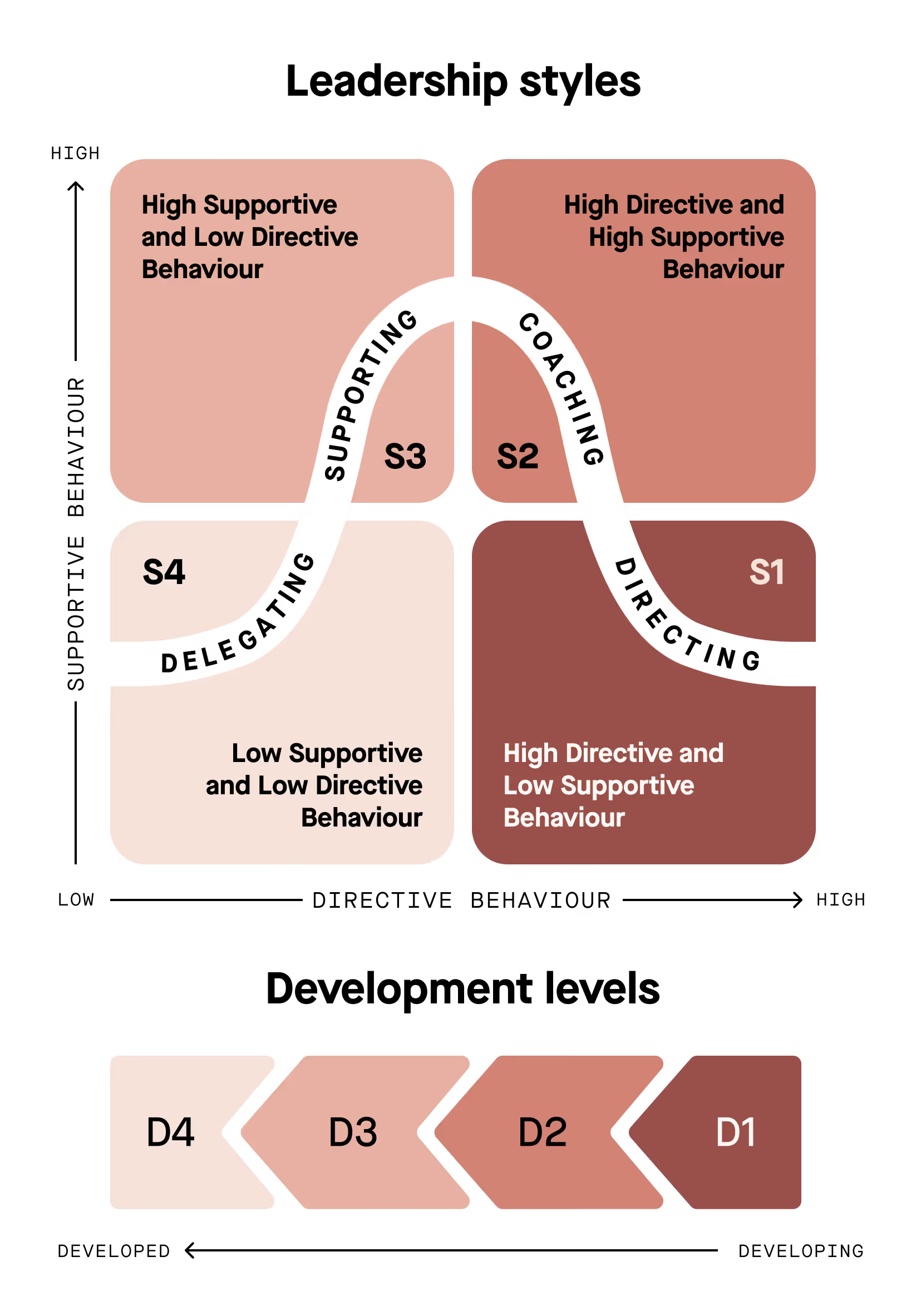
Directing: High direction, low support
If your employee has never attempted a task you’ve assigned them, they’re likely to need detailed instructions on how to tackle it. Here’s how you can help:
- Break the task down into actionable steps
- Assign a priority level to each task
- Schedule regular check-ins to track progress
Coaching: High direction, high support
Coaching is a beneficial style of leadership when it comes to supporting employees who are keen on performing a task, but just don’t know how to. To help them take more ownership of their work, you can:
- Give them as much information as they need about the task
- Allow them to try their hand at it
- Keep communication channels open when they run into any problems
Supporting: Low direction, high support
When supporting, act as a sounding board to your employees. An employee may ask you if their work is good enough or in line with your expectations. You must:
- Encourage them to make decisions themselves
- Reassure them if they doubt their capabilities
- Remind them that you trust their judgment
Delegating: Low direction, low support
Delegating means that an employee is in entirely in charge of the project. They’ve likely done this before, know how to navigate challenges, and need very little of their leader’s involvement. To best support your employee:
- Let them take the reins of the project
- Be accessible if they have questions
How is situational leadership different from traditional leadership styles?
It prioritises adaptability
Traditional leadership styles (such as authoritarian, democratic, or laissez-faire leadership) tend to promote one single rule that is applied broadly regardless of the situation.
As you can imagine, this doesn’t always work.
Situational leadership is built around adaptability. There is no “best” way to lead, and every situation demands a different approach.
It adopts an employee-focused approach
As Anise put it: “True leadership is adapting your approach to the specific needs of the person in front of you.”
While traditional leadership styles ask someone to consider “What kind of leader am I?”, situational leadership encourages leaders to consider “What does this person need from me right now?”
This helps you build trust with your employee, reassuring them that their best interests are being considered. It also helps you directly address any areas of growth and improvement, further making employees feel supported and understood.
It embraces equity over equality
Traditional leadership styles encourage leaders to treat all their employees equally.
And on the surface, treating everyone equally might seem fair. But in practice, it often isn’t.
A new starter and an experienced employee won’t benefit from the same level of direction or autonomy.
Situational leadership embraces equity over equality. It recognises that people have different levels of competence, confidence, and motivation, and adjusts leadership accordingly.
How do I implement situational leadership at work?
While there is no specific formula (it’s, well, situational) there are a few things you should consider when applying situational leadership in the workplace:
Step 1: Assess competence and commitment
Before deciding how to lead, take some time to understand how your employee feels about a certain task. This will help you avoid over-managing confident employees or under-supporting those who need a little extra assistance.
Here are some basic questions to ask:
Competence:
- Have you ever done this task or a similar one before?
- Do you have a plan? Where are you going to start?
- What do you find the easiest or the most challenging part of this assignment??
Commitment:
- Are you excited about this project?
- Do you have any concerns or reservations?
- What would make this work more engaging or manageable?
💡Pro tip: Remember to observe what they say and how they say it. Looking out for signs of hesitation or confidence will help you make your decision.
Step 2: Choose your style
The leadership style you choose should match your employee’s competence and commitment for the task.
Directing is suited for people who have little experience with the task and need clear instructions.
Coaching works best for people who are familiar with the task but need more encouragement as they learn.
Employees who are good at the task but lack full confidence in their capabilities can benefit from the supporting style.
Delegating is most effective for employees who are highly motivated and experienced at the task.
Step 3: Adjust as you go
Situational leadership is dynamic. As competence and confidence fluctuates with every task, your approach should evolve.
While your employee might be experienced in one area and benefit from the delegating style, in other tasks they may need closer guidance (directing style).
Don’t be afraid to adjust your leadership style as you notice your employee’s approach change mid-task, either.
Choose your adventure: Leadership edition
Theory is great, but you’ll only see results if you can put it into practice.
So let’s test your situational leadership skills: With every scenario below, assess the situation and choose the situational leadership style that will get you and your team the best results.
Don’t worry, we’ll give you all the information you need to make your decision.
Scenario 1
Your team just welcomed a new graduate. They’re full of energy and enthusiasm, happily tackling every task you assign them. But you’ve noticed that sometimes they spend too much time perfecting minor details, slowing down overall progress.
How would you help them?
- Allow them time to experiment and find their own rhythm, trusting they’ll learn through trial and error
- Repeatedly remind them that you are not looking for perfection
- Outline priorities, expectations, and a timeline to complete each task
- Set up regular check-ins to review progress and give constructive feedback while letting them handle the tasks independently
Answer: 3 - Directing style.
If this is your employee’s first job, they probably haven’t mastered prioritisation yet. Providing them a clear roadmap with expectations and priorities highlighted will help them focus on what’s important, reduce wasted effort, and teach them how to make these decisions for themselves.
Scenario 2
One of your brightest employees has just been promoted to a first-time manager. They’re excited, but unsure about some of their responsibilities as a leader. They frequently ask for your advice before making decisions.
What would you do?
- Encourage them to make decisions independently so that they can learn from their mistakes
- Take over decisions so things go smoothly
- Share your experience from similar situations and walk them through possible outcomes, asking for their input along the way
- Check in occasionally but mostly let them handle it themselves
Answer: 3 - Coaching style.
This employee is capable but needs guidance as they navigate new responsibilities. By sharing your experience, offering advice, and asking for their input, you’re building their confidence while helping them develop leadership skills. This approach balances support with active learning, which is the heart of the coaching style.
Scenario 3
One of your junior team members is sharp, detail oriented, and has interesting ideas, but refrains from voicing their opinions in group settings. Recently they spotted an error in a senior leader’s plan but stayed silent.
How would you approach this situation?
- Respect their decision not to challenge leadership
- Privately reinforce the value of their insight and encourage speaking up
- Raise the concern yourself without mentioning it
- Suggest sharing thoughts via email instead
Answer: 2 - Supporting style.
This employee might be conscious about saying the “right” thing in meetings and other group settings. Letting them know that their insight is valued and that they will not be penalised for correcting an error will make them feel more at ease.
Scenario 4
A team member consistently delivers strong results and anticipates issues before they arise. On a new project they’re working on, they remain calm under pressure, take initiative to fix problems, and are often the person team members go to for insights.
What would you do?
- Continue reviewing decisions to maintain consistency
- Assign more tasks in their current role to maximise efficiency
- Ask them to document their process for the team
- Invite them to take the lead on a project with periodic check-ins
Answer: 4 - Delegating style.
This employee possesses the experience and the proactive attitude necessary to lead a project, seeing it through from start to finish. Scheduling periodic check-ins will give them the opportunity to ask any questions that might arise as they tackle the task.
Final thoughts: Situational leadership and International Women’s Day 2026
If there is one thing you should take away from this blog post, it’s this: leadership is not one-size-fits-all. Every person, every task, and every situation is unique, demanding different approaches from a leader.
This International Women’s Day, consider this your invitation to rethink what leadership can look like, embrace adaptability over formula, and lead with empathy.
Looking for more ways to level up your leadership and stay ahead of the HR curve? Join The Herd, Zinc's community of forward-thinking HR and talent professionals, for IRL events and a monthly dose of news straight to your inbox.