


Adverse media checks
Quickly spot reputational risks before you make big hiring decisions. Zinc’s fast, compliant checks help stay confident and protect your workforce.

Search credible news sources for links to serious reputational concerns

Combine with sanctions and PEP checks for confident senior hires

Get results in one minute

What you need to know
Turnaround times
Available in
195 countries
Including
UK
USA
France
Germany
Spain
and more








Not all bad behaviour turns into a criminal record. Get the full picture with adverse media checks to protect your business.

Avoid unpleasant surprises
Even if a criminal record is clear, there might still be historic behaviour that influences your hiring decision. Adverse media checks make sure that information from other public sources doesn’t catch you by surprise during the hiring process.

Protect business reputation
For better or for worse, your employee’s public behaviour represents your brand. Pairing adverse media checks with sanctions and PEP checks helps you feel confident in hiring leaders with public profiles and protects your sales process from risk.

Get thorough results
Automated checks run through hundreds of media sources to make sure your results are as thorough as possible. Avoid manual mistakes and blind spots, and feel confident that you’re well informed and in control of all the information.

See it in action
Book a demo and choose a time to speak with one of our experts about a custom solution for your business.

36
minutes

Average turnaround time

195
countries
Supported by Zinc

519,274
Adverse media checks (as of May 2026)
Fast, comprehensive reports help you spot candidate risk no matter where you’re hiring.
Detailed, global reports
Protect your business reputation
Fast, non-invasive candidate screening
Integrated with your HRIS or ATS



A better switch.
“Our experience has been great. We’re really pleased we switched to Zinc, it’s a much better product and platform for our team, and definitely a smoother experience for our candidates too.”

Quickly spot adverse media results, without adding any extra steps for candidates or your team.
Step one
If you’ve added adverse media screening to your package, it runs automatically with nothing extra needed from candidates.
Step two
Your candidate’s name and identity details are used to query a watchlist that’s updated periodically with adverse news coverage. Fuzzy name matching catches results even where middle names are left out, erring on the side of caution rather than missing results.
Step three
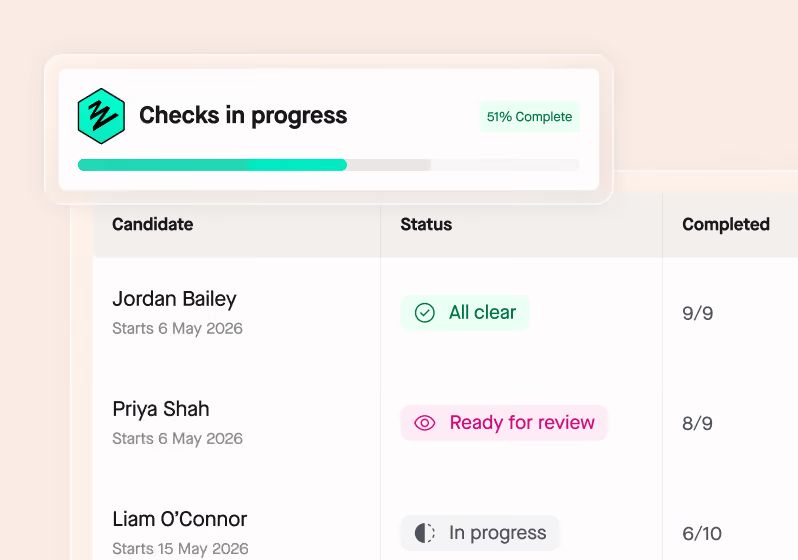
Matches get flagged in your dashboard alongside the candidate’s other results. When you run adverse media checks alongside PEP and sanctions screening, you get a fuller picture of legal restrictions and reputational risks before you make big hiring decisions.


Integrations
Background checks, integrated
Zinc connects directly with your ATS or HRIS at no additional cost. Send checks, get results, and store reports without leaving your preferred platform.
Why businesses love using Zinc




%%An intuitive, easy platform%% with support that's far quicker than other providers. The answers are always reliable, especially when we're dealing with different countries.

%%The candidate experience is excellent.%% Integration was straightforward, the pricing is among the best on the market, and support is quick and consistently helpful.

%%It automates the screening of new employees%% and integrates well with our ATS and HRIS. The initial setup was super easy and we're really happy with the product.
Onboarding takes just a few minutes and %%running checks for international contractors is seamless%%. The pay-per-use model is a huge plus for a small company like ours.
%%It has made my role, and my colleagues' day to day, much easier and more efficient%%, while significantly improving the overall experience for our candidates.
Checks and paperwork sync automatically with our recruitment and HR systems, %%saving us so much time%% not having to check multiple systems. The support teams are always incredibly helpful.
For teams of every size
Flexible background checks
Whether you’re hiring a little or a lot.

Under 20 hires annually
Pay As You Grow
Get started in minutes. Our Pay As You Grow plan is built for lower hiring volumes — a flat rate per check, with no hidden costs or setup fees.

Start checking in minutes, no setup needed
Flat rate per check, no hidden fees
Pay only for what you use
20+ hires annually
Custom solutions
For larger volumes, our experts build a package around your needs. Flexible with your hiring and never expires, with integrations, setup, training, and support all included free.
A custom package built around your hiring
Credit pool that never expires or rolls over
Integrations, setup, and training included free
More from Zinc
Check out more resources, straight from our experts



Start screening in days, not weeks
Combine this check with right to work, references, criminal records and more, across 195 countries, in a single candidate journey.
What is the difference between adverse media screening and social media screening for employers?
Adverse media screening searches structured news databases, national and international publications, trade journals, legal filings, and official records for coverage linking a candidate to financial crime, fraud, regulatory violations, or other serious reputational concerns. The sources are authoritative and the focus is on documented events.
Social media screening reviews a candidate's own public activity across platforms like LinkedIn, X, Instagram, and TikTok, looking at whether their posts, interactions, or associations raise concerns about conduct, values, or reputational risk. Adverse media tells you what credible external sources have reported about a candidate. Social media screening tells you what the candidate has publicly said and done themselves.
For senior hires, running both gives you the most complete picture. If you’re running checks at a financial services firm, this combination helps you identify non-financial misconduct, including bullying, harassment, or discriminatory behaviour, in line with FCA fitness and propriety assessments under SMCR.
Who should run adverse media screening, and in which roles and industries?
Adverse media screening is most relevant for senior executive and board-level hires, where a candidate's public profile and past conduct directly affects organisational reputation. In financial services, it forms part of responsible due diligence for SMCR roles where fitness and propriety is being formally assessed.
For roles with public procurement authority, significant external-facing responsibility, or access to sensitive client relationships, it adds assurance that criminal and reference checks alone can't provide.
The FCA introduced annual open-source internet searches as a Good Practice recommendation for regulated firms in 2018. The December 2025 SMCR Non-Financial Misconduct guidance, in effect from September 2026, makes this type of screening increasingly expected. Adverse media checking is also relevant under BS7858 vetting for security-sensitive roles.
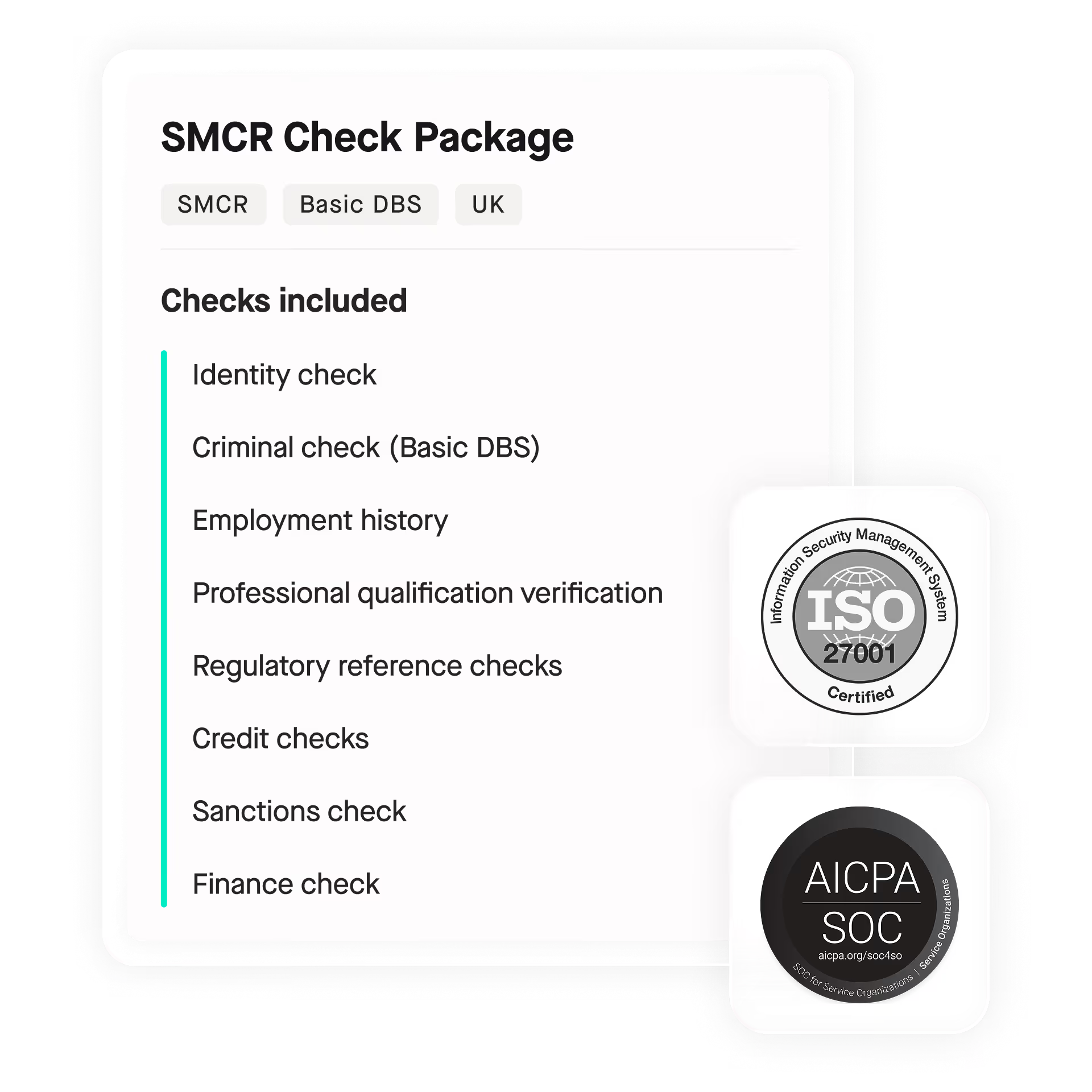
Learn more about FCA, CQC, or Ofsted regulatory requirements.
What sources does Zinc search for adverse media results?
Zinc's adverse media checks run through the Entrust Watchlist, the same infrastructure used for PEP checks, scanning negative news coverage and media mentions from a periodically updated database. The check uses a fuzzy name matching algorithm to identify potential matches and account for name variations.
Content is categorised by risk type, including media relating to accusations, criminal activity, arrest, trial, and exoneration, and any results linked to the candidate's name are flagged in your dashboard for review. Results typically come back in approximately one minute.
Should adverse media checks be combined with PEP and sanctions screening?
Yes. For senior hires, regulated roles, or any position with significant reputational or financial risk, running all three together is best practice.
Each check covers a different type of risk the others don't fully address. Sanctions identifies legal prohibitions. PEP identifies political influence risk. Adverse media surfaces documented public concerns not captured in structured databases. Together, they give you the most complete pre-hire due diligence picture available. In Zinc, all three are included in a single package, run on the same identity data, and return to the same dashboard view. There's no additional candidate friction and no extra configuration for your team.
How does Zinc prevent false positives in adverse media screening?
Zinc’s name matching algorithm errs on the side of caution, casting a wider net to make sure genuine matches aren't missed. This means candidates with common names can generate potential matches that relate to different individuals. The check flags these for your team's review rather than treating them as confirmed findings. You’ll have the ability to leave comments on the result for audit purposes if you choose to either reject the candidate, or mark the results as all clear.
Your team reviews each flagged result against the candidate's confirmed identity details before factoring it into a hiring decision. Running adverse media alongside PEP and sanctions screening helps with this, too. A concern appearing across multiple checks is more likely to represent a genuine match than something appearing in a single channel only.
How long does an adverse media check take when run through Zinc?
Adverse media checks through Zinc return results in approximately one minute on average. The check runs automatically once identity verification is complete, and there’s no extra input needed from your team or the candidate. Results appear in your Zinc dashboard straight away alongside all other screening data.
Adverse media checks are typically run as part of a combined due diligence package with PEP and sanctions screening. Because all three use the same identity data from onboarding, the combined package adds minimal time to the overall process while significantly increasing the depth of your pre-hire risk assessment.
View all of Zinc’s live turnaround times here
